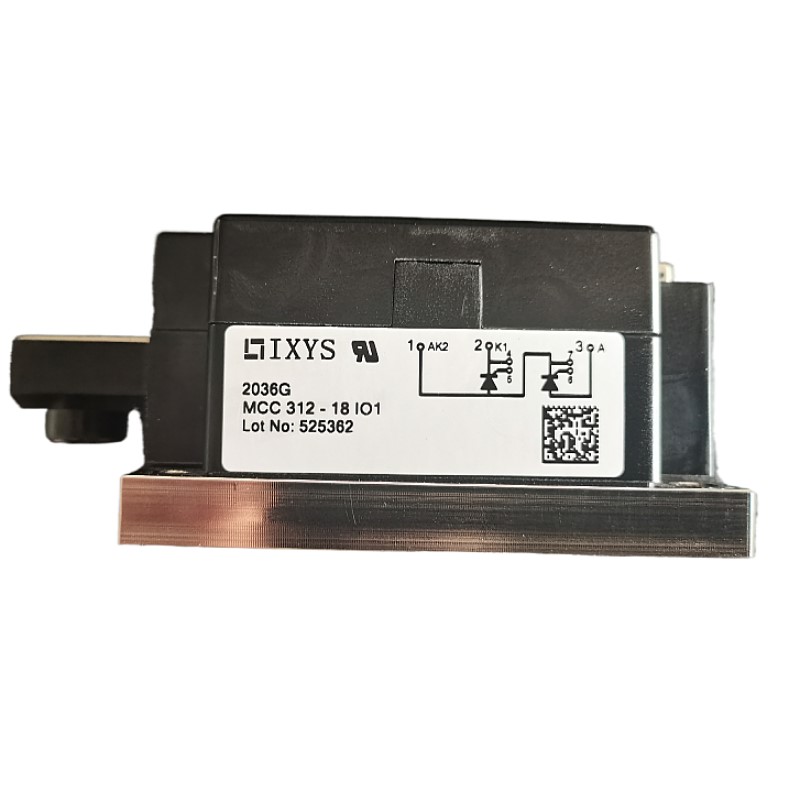
Semikron & IXYS Thyristors – Industrial Power Electronics and Drive Components
Brand name: HANI
Packing Details : Wooden box with fumigation or Wooden Fram or Steel Frame
Delivery Details: 30~60days or Based on the quantity
Shipping: Sea freight、Land freight、Air freight
HANI specializes in industrial electrical automation, delivering integrated drive and control solutions to safeguard your production.
Product Details
Semikron & IXYS Thyristors – Industrial Power Electronics and Drive Components
In modern industrial automation products, power semiconductors form the backbone of reliable energy control. Among the most established devices, thyristors from Semikron and IXYS have been trusted for decades to regulate high currents, manage motor control, and secure phase‑angle operations in harsh factory environments. Whether it is a soft‑starter for a 400 kW induction motor, an AC‑DC converter in a steel mill, or a temperature controller using burst‑firing logic, these components deliver the robustness that no pure IGBT solution can easily replace. For drive engineers building industrial automation products, the Semikron and IXYS thyristor families represent a balance of massive surge capability, easy gate‑drive design, and backward compatibility with legacy equipment that keeps entire production lines running without expensive redesigns.
HANI’s technical team frequently specifies both Semikron and IXYS thyristors when designing power stages for industrial automation products that must endure overloads, voltage transients, and continuous vibration. This article explores the physical principles, product ranges, selection criteria, and practical implementation details that give these components their enduring place in the industrial landscape.
1. Why Thyristors Remain Essential in Industrial Automation Products
Thyristors are four‑layer (PNPN) latching switches that conduct once a gate pulse is applied and continue conducting until the load current falls below the holding current. Unlike transistors, they do not require a continuous gate signal, which simplifies control power supplies in industrial automation products. A single high‑energy pulse can turn on a hockey‑puck thyristor carrying 3000 A, after which the device stays in the “on” state naturally at the next zero‑crossing. This latching behaviour makes thyristors ideal for phase‑control rectifiers, AC regulators, and cyclo‑converters, which are still core elements of industrial automation products such as DC drives, electrolysis rectifiers, and large UPS systems.
Compared to IGBTs, thyristors exhibit significantly higher surge current ratings for a given die area. A typical 1600 V, 150 A thyristor can withstand 10 ms half‑sine surges of 4000 A or more, while an IGBT module of similar rating would fail at much lower levels. This ruggedness is mandatory in industrial automation products that face frequent line disturbances or motor inrush. Moreover, thyristors generate conduction losses dominated by a forward voltage drop of about 1.5–2.5 V, which, at thousands of amperes, still results in manageable heat dissipation when proper double‑sided cooling is employed. The absence of tail current, a major switching‑loss component in IGBTs, means that thyristors operating at 50/60 Hz achieve excellent efficiency in naturally commutated circuits. For these reasons, any serious lineup of industrial automation products still includes thyristor‑based power stages, and Semikron together with IXYS dominates this segment.
2. Semikron Thyristor Portfolio – Proven Power for Heavy Industry
Semikron, a German power electronics pioneer, has been manufacturing disc‑type and module‑type thyristors since the 1960s. The catalogue covers voltage classes from 600 V to 2200 V and current ratings from a few tens of amperes up to several thousand amperes. The SKT (hockey‑puck) and SKKT (dual‑thyristor module) series are the most widely used in industrial automation products such as soft‑starters, welder controls, and high‑power rectifiers. Inside a Semikron module, the chips are pressure‑contacted using a proprietary pressure system that guarantees low thermal resistance and excellent thermal cycling capability – essential for industrial automation products that experience daily start‑stop cycles.
A representative device, the SKKT 162/16 E, integrates two thyristors in a common‑cathode configuration rated at 1600 V and 162 A (Tcase = 85 °C). It features an isolated baseplate with 3000 V AC insulation, allowing direct mounting on a common heat‑sink without isolation shims – a major advantage for compact industrial automation products. Gate‑triggering requirements are specified at 2 V, 150 mA typical, so the device can be driven directly from microcontrollers through galvanically isolated pulse transformers. The SKT 1200/16E, on the other hand, is a single‑thyristor disc rated 1600 V / 1200 A and is often found in the DC link of large motor drives where the highest possible industrial automation products reliability is non‑negotiable.
Semikron also offers fully integrated bridge assemblies, such as the SEMIPONT and SEMITOP rectifier bridges, which include thyristors, diodes, heat‑sink, and snubber circuits in one rugged package. For an OEM developing industrial automation products for conveyor systems, a SEMIPONT module can cut engineering time by 30–40 % while guaranteeing UL‑recognized isolation. Every Semikron thyristor undergoes 100 % dynamic testing, including di/dt stress and dv/dt immunity, guaranteeing the parameters listed in the datasheet are met under real‑world conditions.
3. IXYS Thyristors – Compact, Gate‑Sensitive Solutions
IXYS, now part of Littelfuse, has long been recognised for producing thyristors with exceptionally low gate‑trigger currents, enabling direct logic‑level drive in industrial automation products where cost‑sensitive gate‑drive circuits are required. The MCC series (e.g., MCC56‑16IO1B) places two thyristors in a compact, fully isolated TO‑240‑like module that fits seamlessly into industrial automation products such as temperature controllers, small DC drives, and lighting dimmers. With a gate‑trigger current as low as 5 mA for sensitive gate versions, these devices can be driven straight from a 3.3 V CMOS output, removing the need for bulky pulse transformers in low‑power stages.
IXYS also specialises in phase‑control thyristors with enhanced dynamic characteristics. Devices such as the CLA50E1200HB offer a repetitive peak off‑state voltage of 1200 V and an RMS on‑state current of 80 A with turn‑off times (tq) as low as 15 µs. This enables their use in inverter circuits and forced‑commutated converters that sit at the heart of some advanced industrial automation products, including active front‑end drives and induction heating equipment. The IXYS Westcode disc family extends the current range up to 6000 A, providing the raw power needed for aluminium smelters and railway traction substations – extreme examples of industrial automation products operating in mission‑critical infrastructure.
Both Semikron and IXYS ensure long‑term availability, with formal product lifecycle policies that guarantee supply for 15–20 years. For industrial automation products that are expected to operate 24/7 for decades, this longevity is just as important as electrical specifications. HANI holds stock of both standard and hard‑to‑find Semikron/IXYS thyristors, enabling rapid replacement and avoiding costly machine downtime.
4. Comparative Selection Data – Semikron vs. IXYS Thyristors
The table below summarises key parameters for mid‑range thyristors commonly used in industrial automation products. All values are extracted from official datasheets (valid as of 2025) and serve as a quick reference for design engineers.
| Parameter | Semikron SKKT 162/16 E | IXYS MCC56‑16IO1B | Recommended Industrial Automation Application |
|---|---|---|---|
| Repetitive peak off-state voltage (VDRM/VRRM) | 1600 V | 1600 V | Mains 400 V–690 V motor drives |
| Average on-state current (ITAV) | 162 A (Tc=85 °C) | 2x 56 A (Tc=85 °C) | Small fans, pumps, compact starters |
| Surge current (ITSM, 10 ms, Tj=125 °C) | 5200 A | 1500 A | Short‑circuit withstand in automation |
| Gate trigger current (IGT, typ.) | 150 mA | 5–50 mA (sensitive version available) | Logic‑level drive vs. robust pulse transformer |
| Isolation voltage (module baseplate) | 3000 V AC | 3000 V AC | Common heat‑sink mounting |
| Critical di/dt | 150 A/µs | 100 A/µs | Snubber design requirements |
Such a comparison helps developers of industrial automation products to quickly match a thyristor to the load profile. Semikron typically provides higher current modules with an industrial screw‑terminal layout, whereas IXYS focuses on compact footprint and ultra‑low gate drive, which is ideal for embedded industrial automation products like programmable logic controllers with integrated power outputs.
5. Integration into Drive Components – Production‑Oriented Guidelines
A thyristor cannot work in isolation; in industrial automation products it must be surrounded by gate‑drive circuits, snubber networks, heat‑sinks, and over‑current protection. For a three‑phase fully controlled bridge used in a DC drive (a classic among industrial automation products), the following rules of thumb apply:
- Snubber design: To limit dv/dt below the device’s critical value (typically 500–1000 V/µs), a series RC snubber is placed across each thyristor. A commonly used starting value in industrial automation products is 0.22 µF + 10 Ω for 1600 V devices running on 400 V mains. Detailed tuning should reference Semikron application note AN‑8004 or IXYS application brief IXAN‑003.
- Gate pulses: A strong, fast‑rising gate pulse (5–10 V, diG/dt ≥ 1 A/µs) ensures the thyristor latches uniformly across the entire silicon area. For industrial automation products with multiple paralleled thyristors, gate‑drive transformers with bifilar winding are preferred to enforce simultaneous triggering and avoid dynamic current imbalance.
- Thermal management: Using the maximum junction temperature of 125 °C and a typical Rth(j‑c) of 0.12 K/W for a disc‑type Semikron thyristor, one can calculate the required heat‑sink. For industrial automation products operating in 50 °C ambient, forced‑air cooling or liquid cooling becomes mandatory above 800 A RMS.
- Over‑current coordination: Semiconductor fuses (I²t rating below the device I²t limit) must be placed in series. For the SKKT 162/16 E, the I²t for a 10 ms pulse is 135,000 A²s, so a Bussmann FWP‑200A fuse (I²t ≈ 100,000 A²s) gives safe coordination – a common practice in reliable industrial automation products.
Many of these integration details are covered in the design guides that HANI distributes together with its power semiconductor kits. By pre‑assembling the gate‑drive board and heat‑sink interface, HANI helps OEMs accelerate the deployment of Semikron and IXYS thyristors into their final industrial automation products.
6. Manufacturing and Quality Systems – What Makes These Thyristors Fit for Industrial Automation Products
Both manufacturers employ deep process technologies to ensure thyristors survive the demanding life of industrial automation products. Semikron uses diffusion and alloy processes on monocrystalline silicon that is neutron‑doped to achieve very tight resistivity tolerance – crucial for predictable breakdown voltage. The passivation uses a combination of glass and polyimide to achieve a stable off‑state leakage below 10 mA even at 125 °C, directly impacting the long‑term drift of industrial automation products in hot control cabinets. IXYS relies on a planar junction termination with guard rings, which gives excellent blocking stability over a wide temperature range and is a key reason why IXYS thyristors are chosen for outdoor industrial automation products such as solar inverter bypass circuits.
Both lines are manufactured in ISO 9001 / IATF 16949 certified facilities. Full traceability through wafer lot number and assembly date means that if a field return arises from a customer’s batch of industrial automation products, the root cause can be precisely isolated. For high‑reliability industrial automation products like railway signalling power supplies, Semikron offers optional burn‑in and 100 % X‑ray inspection of solder joints.
7. Real‑World Application Examples in Industrial Automation
Soft‑starter for a 250 kW conveyor belt: A three‑phase anti‑parallel thyristor stack built with Semikron SKKT 273/16 modules reduces the inrush current from 6× In to 2.5× In. Because the thyristors phase‑control the voltage ramp, the mechanical stress on the gearbox is drastically reduced. This is a classic case of industrial automation products extending machine lifetime through power electronics.
DC drive for a wire‑drawing machine: A fully controlled six‑pulse bridge using IXYS MCC95‑16IO1B modules supplies a 150 kW DC motor with smooth speed regulation. The inherent line‑commutated operation keeps harmonic current distortion within IEEE 519 limits without active filters, making the system one of the most cost‑effective industrial automation products for metal processing lines.
Temperature control in plastic extrusion: A burst‑fired thyristor controller using Semikron’s SKKT 57 modules regulates heater bands with zero‑cross detection to avoid EM interference. Such precise control is a must for industrial automation products where product quality depends on temperature stability within ±1 °C.
In each scenario, the core requirement — turning massive power on and off reliably over millions of cycles — is met because the thyristor remains the most mature semiconductor technology for line‑frequency switching in industrial automation products.
8. Frequently Asked Questions (FAQ)
Q1: Are IXYS thyristors still manufactured under the Littelfuse acquisition?
Yes. Since the Littelfuse acquisition, all IXYS thyristor product lines have been preserved and are actively produced in existing fabs. Datasheets remain fully valid, and the part numbers continue unchanged. For engineers maintaining long‑life industrial automation products, this means existing designs can be re‑ordered without qualification risk, and new designs can still count on the original IXYS specifications.
Q2: How do I replace an obsolete Semikron thyristor module in a legacy industrial drive?
Semikron maintains comprehensive cross‑reference tables. Usually, an older part like the SKKT 106B can be replaced by an SKKT 106/16E (E‑type passivation) with identical footprint. The key is to verify the gate‑trigger requirements remain within the existing driver’s capability. Because industrial automation products often have custom‑wound isolation transformers, a small adjustment of the gate series resistor may be needed – an area where HANI’s retrofit documentation provides step‑by‑step guidance.
Q3: Can I parallel Semikron or IXYS thyristors for higher current in industrial automation products?
Yes, parallel operation is common in high‑current industrial automation products. To ensure current sharing, select devices with closely matched on‑state voltage (VT), employ symmetric bus‑bar layouts, and use the same gate‑drive transformer secondaries to trigger all parallel thyristors simultaneously. A derating of 15–20 % is recommended. Semikron application note AN‑17 provides formulas for calculating dynamic and static imbalance.
Q4: What is the typical lifetime of a thyristor in an industrial automation product?
When operated within datasheet limits — junction temperature below 125 °C and blocking voltage below 80 % of VDRM — thyristors can exceed 30 years of continuous service. The dominant aging mechanism is thermal cycling of the chip‑solder interface. In properly cooled industrial automation products, a ΔTj of 40 °C yields well over 100,000 power cycles. This is why many 1980s‑vintage Semikron rectifiers are still running in steel plants today.
Q5: Which thyristor is better for a compact drive – Semikron SKKT or IXYS MCC?
For industrial automation products that value micro‑ampere gate drive and PCB‑mountable form factor, the IXYS MCC series is often the first choice. When the requirement shifts to higher rms current (above 80 A) and easier scalability, the Semikron SKKT modules are preferred. The decision ultimately depends on the specific thermal and mechanical constraints of your industrial automation products.
9. Summary and Production Value
Semikron and IXYS thyristors deliver a unique combination of surge ruggedness, design simplicity, and thirty‑year lifecycle support that solid‑state alternatives cannot yet match. For anyone developing, maintaining, or upgrading industrial automation products, understanding these devices — from their physical limitations to their mounting torque specifications — directly translates into reduced field failures and lower warranty costs. The reference table, snubber calculations, and integration hints presented here are intended to serve as a practical checklist during the design review of any thyristor‑based stage.
Whether you are selecting a replacement thyristor for an older drive or designing a next‑generation motor controller, the Semikron and IXYS catalogues provide electrically robust, fully documented solutions that adhere to the strictest manufacturing quality standards. For production engineers working on industrial automation products, having a supply partner that understands the technical nuance is indispensable — and that is exactly where HANI connects specification with implementation.
Last updated: May 2026. All semiconductor data should be verified against the latest manufacturer datasheets before finalising BOMs for industrial automation products.
HANI is one of China’s leading professional industrial electrical automation manufacturers, providing complete drive and control solutions to customers worldwide. HANI focuses on designing and manufacturing integrated automation systems that meet the industry’s highest standards of precision, efficiency, and durability. Our engineering expertise lies in providing turnkey electrical automation projects to optimize the performance of modern industrial manufacturing plants.