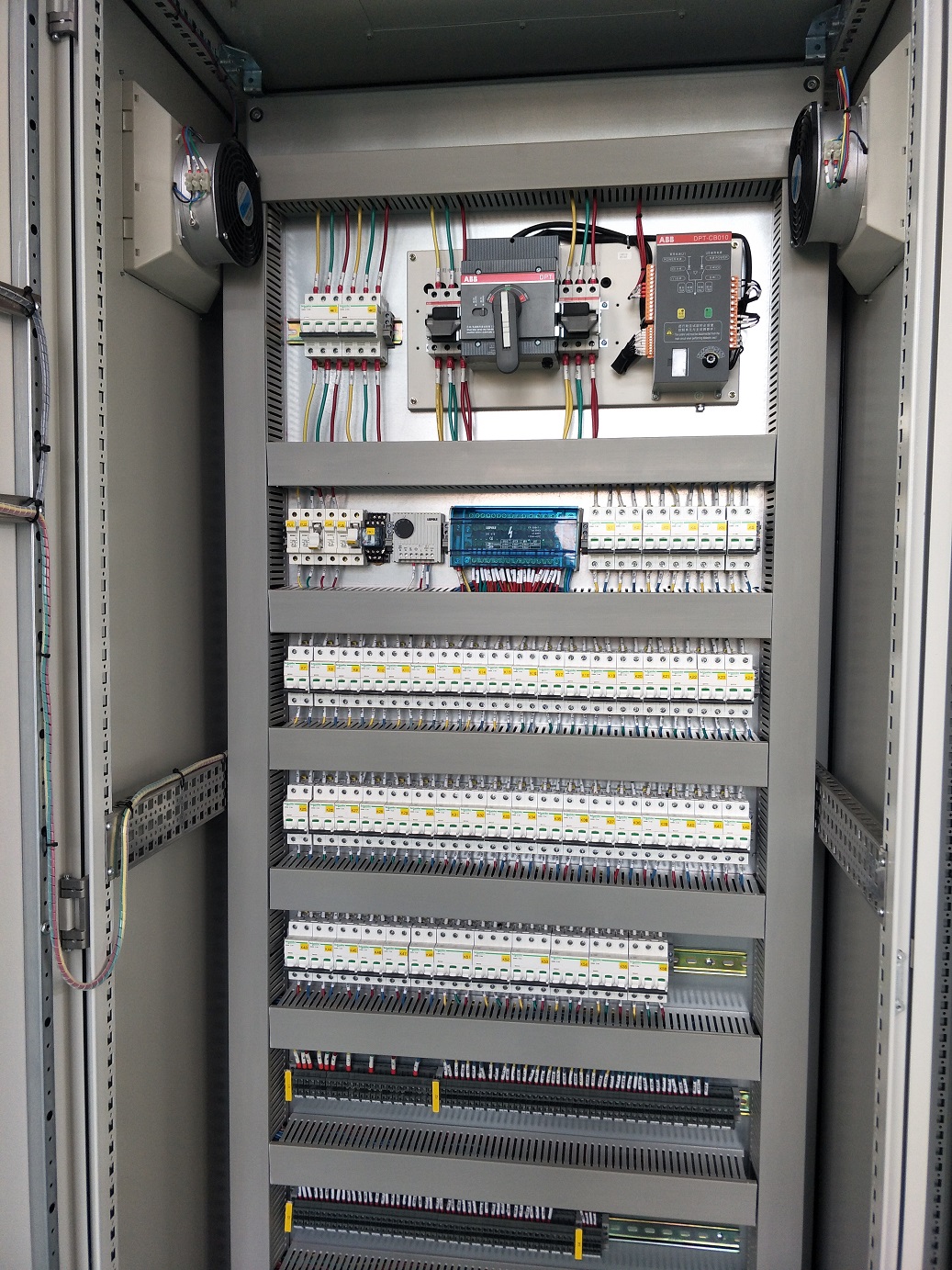
Industrial Automation Control Cabinet – Custom Electrical Control Panel Manufacturer
Brand name: HANI
Packing Details : Wooden box with fumigation or Wooden Fram or Steel Frame
Delivery Details: 30~60days or Based on the quantity
Shipping: Sea freight、Land freight、Air freight
HANI specializes in industrial electrical automation, delivering integrated drive and control solutions to safeguard your production.
Product Details
Engineered Control Solutions
Industrial Automation Control Cabinet – Custom Electrical Control Panel Manufacturer
From concept to commissioning: purpose-built automation enclosures that protect, organise, and optimise your critical industrial control systems.
Every industrial process—whether a water treatment plant, a robotic assembly cell, or a continuous caster—depends on a central nervous system of relays, PLCs, drives, and networking equipment. The enclosure that houses these components, the electrical control panel, is far more than a metal box. It is an engineered assembly that protects personnel from electrical hazards, shields sensitive electronics from electromagnetic interference, manages the thermal output of power‑dense devices, and provides the structured wiring infrastructure that makes maintenance efficient and fault‑finding rapid. A generic enclosure can house components; a custom Automation Control Cabinet optimises their performance, extends their service life, and simplifies the work of the technicians who interact with it daily.
As a specialist electrical control panel manufacturer, HANI designs and builds control cabinet solutions that are tailored to the exact requirements of the application, the installation environment, and the applicable electrical codes. Whether the project calls for a single‑door wall‑mounted PLC Automation Control Cabinet or a multi‑bay free‑standing drive system, the engineering discipline applied is the same: rigorous thermal analysis, structured cable management, full‑load factory testing, and comprehensive documentation. This article describes the engineering substance behind a high‑integrity custom design control cabinet and explains why off‑the‑shelf alternatives often prove more costly over the asset’s lifetime.
Beyond a Standard Box – The Case for Custom Electrical Control Panel Design
An electrical control panel that is designed and built as a bespoke assembly delivers value in three dimensions: it matches the exact physical footprint and IP rating required for the site, it integrates all power, control, and safety devices into a tested and labelled system, and it arrives on site complete with schematics and test certificates. In contrast, an adapted standard enclosure often results in compromises—undersized busbars, inadequate ventilation, or a layout that forces maintenance electricians to work in confined, poorly lit spaces. A custom design approach eliminates these hidden costs from the outset.
Custom Control Cabinet – Engineering and Manufacturing Scope
The following table summarises the typical scope of a custom design Automation Control Cabinet project, from initial specification through to site commissioning. Each stage is governed by the relevant IEC and EN standards, ensuring that the finished electrical control panel meets both regulatory and operational requirements.
| Engineering Phase | Key Activities | Deliverables |
|---|---|---|
| Front‑End Engineering | Define electrical load list, I/O count, networking topology, thermal budget, enclosure IP rating, and applicable standards. | Functional Design Specification (FDS) |
| Detailed Design | 3D layout of all components, thermal simulation, busbar and cable sizing, component selection, schematic generation. | General Arrangement, Schematics, BOM |
| Panel Construction | Enclosure fabrication or selection, component mounting, wiring, labelling, termination, and internal testing. | Assembled control cabinet |
| Factory Acceptance Test | Dielectric test, insulation resistance, functional test of all circuits, temperature‑rise test at rated load, safety function verification. | FAT Report & Certificates |
| On‑Site Commissioning | Installation, cabling to field devices, power‑up, loop check, PLC program upload, and production handover. | Commissioned electrical control panel |
* Every custom design Automation Control Cabinet is built in accordance with IEC 61439‑2, and the manufacturer’s declaration of conformity is issued with the panel. The testing protocol is tailored to the installed equipment; for example, a control cabinet containing variable frequency drives will undergo additional harmonic and EMC verification.
Thermal, EMC, and Mechanical Design – The Pillars of a Reliable Electrical Control Panel
The three most common causes of premature failure in an electrical control panel are excessive temperature, electromagnetic interference, and mechanical stress on terminations. A custom design addresses all three through disciplined engineering. Thermal management begins with calculating the total heat dissipation of all installed devices—PLCs, power supplies, VFDs, braking resistors, transformers—and then designing an airflow path, or a closed‑loop cooling circuit, that maintains the interior ambient temperature within the rated range of every component. For a compact Automation Control Cabinet housing a 15 kW VFD and a PLC, this may simply mean a filtered fan with a thermostatic control; for a large drive control cabinet, it may require an air‑to‑water heat exchanger and N+1 fan redundancy.
Electromagnetic compatibility is designed into the electrical control panel from the backplane upwards. Sensitive signal cables run in separate trunking from power cables; all screens are terminated on conductive clamps at the point of entry; the enclosure panels are bonded to the protective earth with braided straps; and where necessary, line filters or output chokes are incorporated. These measures are not cosmetic—they are what distinguish a custom design control cabinet that operates without nuisance trips from a standard panel that generates random faults. Mechanical integrity is equally systematic: all heavy components are mounted on reinforced sub‑panels, busbars are braced for the prospective short‑circuit current, and every termination is torqued and marked with an anti‑tamper seal.
Industries Served by Custom Automation Control Cabinets
A bespoke electrical control panel is a requirement wherever standard enclosures cannot meet the demands of the process, the environment, or the applicable regulations. The following sectors are representative of the application range.
Water & Wastewater
Pump stations, UV treatment, and chemical dosing require IP65‑rated control cabinet enclosures with corrosion‑resistant coatings and integrated telemetry. A custom design ensures the panel can operate reliably in a humid, chlorine‑bearing atmosphere for decades.
Material Handling & Logistics
Distributed Automation Control Cabinet units with Ethernet/IP or PROFINET connectivity control conveyors, stackers, and sortation systems. Each electrical control panel is designed for the motor starter and VFD complement of its specific zone.
Process & Heavy Industry
Steel, cement, and chemical plants require multi‑bay control cabinet assemblies housing large drives, PLCs, and safety relays. The custom design integrates arc‑flash protection, finger‑safe busbar systems, and thermographic inspection windows.
Project Execution – Bringing a Custom Electrical Control Panel to Life
A custom design Automation Control Cabinet project begins with a thorough understanding of the client’s electrical single‑line diagram, device list, and control philosophy. From this starting point, the panel designer creates a 3D model that locates every component—down to the terminal blocks and cable trunking—in the correct spatial relationship. This model is reviewed with the client before fabrication commences, ensuring that door‑mounted devices, operator panels, and lifting lugs are positioned for ergonomic use and safe handling. The wiring is then executed to a consistent colour code and ferrule numbering system, and a full point‑to‑point test is conducted before power is applied.
HANI applies a rigorous gated process to every electrical control panel project. After the Factory Acceptance Test, the client is invited to witness the functional testing of all I/O, safety circuits, and communication links. Only when the FAT report is signed off is the control cabinet packed in vapour‑phase inhibitor film and shipped to site with its full documentation set. This formality is not bureaucratic; it is the quality assurance mechanism that ensures the panel will power up and function correctly from the moment it is connected to the field wiring.
Frequently Asked Questions (FAQ)
A standard panel is built to a generic specification that may not match your specific load profile, fault level, or environmental conditions. A custom design electrical control panel is engineered for your exact electrical and mechanical requirements. The thermal design is verified, the short‑circuit withstand is calculated, and the layout is arranged for safe and efficient maintenance. The upfront cost difference between a standard and a custom design control cabinet is often offset within the first year of operation through reduced downtime and easier fault‑finding.
To price and design an Automation Control Cabinet, the manufacturer requires: a single‑line diagram showing the incoming supply, main circuit breaker, and all outgoing loads; a list of the major components (PLC type, VFD ratings, HMI size); the required enclosure IP rating and material (mild steel, stainless steel 304/316); any hazardous area classification; and the site ambient conditions. For a retrofit electrical control panel, photographs and dimensions of the existing installation are also valuable. With this information, a budgetary estimate can usually be provided within a few working days.
A control cabinet built for the European market must comply with IEC 61439‑2, which defines the verification requirements for low‑voltage switchgear and controlgear assemblies. Additional applicable standards include IEC 60204‑1 (safety of machinery – electrical equipment), IEC 61800‑5‑1 (safety for drive systems), and IEC 61000‑6‑2/‑4 (EMC immunity and emission). Where the electrical control panel is destined for marine, mining, or explosive atmospheres, supplementary standards (DNV, MSHA, ATEX/IECEx) are incorporated into the custom design.
A typical single‑bay electrical control panel with a PLC, HMI, and a few motor starters can be designed, built, and tested within 6–8 weeks. More complex multi‑bay control cabinet systems with integrated VFDs, safety PLCs, and extensive I/O may require 12–16 weeks. The critical path is usually the delivery of long‑lead components, particularly large‑rating circuit breakers and specialised drives. Early engagement and prompt component ordering are the most effective ways to compress the schedule without compromising the custom design quality.
Yes. Retrofitting an existing electrical control panel—or replacing it entirely with a new custom design Automation Control Cabinet—is a common project. The approach depends on the condition of the existing enclosure, the obsolescence of the internal devices, and the production downtime window available. Where the enclosure is mechanically sound, the internal back‑panel and all devices can be replaced with a new pre‑wired assembly, reducing the on‑site work. Where the enclosure is also life‑expired, a complete new control cabinet is supplied, engineered to fit within the existing footprint and to connect to the existing field cabling with minimal modification.
HANI provides a 24‑month warranty on all custom design electrical control panel assemblies. Each panel is delivered with a complete documentation pack: schematic diagrams, component datasheets, the FAT report, and a digital copy of the PLC program (where applicable). This documentation is maintained for the life of the asset. HANI also holds a strategic stock of common automation components and can provide technical support, spares, and on‑site service throughout the operating life of the Automation Control Cabinet. The objective is to ensure that the panel remains maintainable and supportable for its full 20+ year design life.
The Engineering Integrity of a Bespoke Control Cabinet
When an electrical control panel is designed, built, and tested as a complete system, the benefits compound over the life of the installation. The panel operates within its thermal limits, so capacitors last their rated hours. The structured wiring and clear labelling mean that a fault can be traced to a terminal in minutes rather than hours. The enclosure withstands the mechanical and environmental stresses of its environment, so it does not deteriorate prematurely. And because every component was selected for the specific application, the panel can be maintained and upgraded without the compatibility problems that plague adapted standard enclosures.
For plant managers and project engineers who are specifying control infrastructure today that must perform reliably for the next 15–20 years, the logic is clear: invest in a custom design Automation Control Cabinet that is built to your specification, tested to international standards, and supported by a manufacturer who treats documentation and after‑sales care as integral to the product. HANI delivers exactly that—a complete control cabinet solution that safeguards the automation investment and contributes directly to the productivity and safety of the plant.
All product and company names are trademarks of their respective holders. Panel specifications are for general reference and must be verified by a qualified electrical engineer for the specific installation.
© HANI Automation Solutions. Engineered electrical control panel assemblies, designed for the demands of modern industry.
HANI is one of China’s leading professional industrial electrical automation manufacturers, providing complete drive and control solutions to customers worldwide. HANI focuses on designing and manufacturing integrated automation systems that meet the industry’s highest standards of precision, efficiency, and durability. Our engineering expertise lies in providing turnkey electrical automation projects to optimize the performance of modern industrial manufacturing plants.