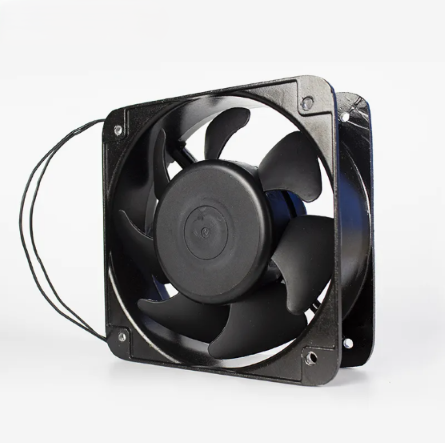
150/120 Industrial Cooling Fan – Thermal Control for Drive Cabinets
Brand name: HANI
Packing Details : Wooden box with fumigation or Wooden Fram or Steel Frame
Delivery Details: 30~60days or Based on the quantity
Shipping: Sea freight、Land freight、Air freight
HANI specializes in industrial electrical automation, delivering integrated drive and control solutions to safeguard your production.
Product Details
150/120 Industrial Cooling Fan – Thermal Control for Drive Cabinets
In the landscape of industrial automation products, effective thermal management is not a luxury—it is a fundamental engineering requirement. Drive cabinets housing variable frequency drives, servo amplifiers, PLCs, and power supplies generate significant heat during continuous operation. Without a robust Cooling Fan solution, enclosure temperatures can quickly exceed component ratings, leading to premature failures, unplanned downtime, and costly production losses. The model introduced here, built around a 150 mm frame and a 120 mm axial depth, integrates active Thermal Control to deliver consistent Drive Cabinet Cooling under demanding shop-floor conditions.
1. Why Drive Cabinet Cooling Matters in Industrial Automation Products
All industrial automation products—from compact logic controllers to high-horsepower drives—share a common vulnerability: excess heat accelerates semiconductor aging. For every 10°C rise in junction temperature, the failure rate of power electronics roughly doubles (Arrhenius law). In enclosed cabinets, natural convection is rarely sufficient. A dedicated Cooling Fan creates forced convection, sharply reducing the thermal resistance between heat sinks and ambient air. This fan’s design specifically targets Drive Cabinet Cooling, where internal air temperatures can swing from 25°C to over 55°C within minutes during peak load. By employing intelligent Thermal Control, the fan adjusts its speed in real time, maintaining a stable enclosure climate and extending the life of all installed industrial automation products.
2. Product Overview – Science-Driven Airflow Design
This Cooling Fan features a square housing measuring 150 mm × 150 mm and a depth of 120 mm, designed for standard cabinet cutouts. The impeller uses a backward-curved airfoil geometry optimized through computational fluid dynamics. The aerodynamic profile minimizes tip vortices, achieving a static pressure of up to 320 Pa while maintaining an airflow volume of 280 m³/h. Such performance is critical in high-density industrial automation products enclosures, where cable ducts and mounting plates obstruct free airflow. High static pressure ensures air penetrates through these obstacles, delivering Drive Cabinet Cooling exactly where it is needed.
3. Technical Specifications
| Parameter | Specification |
|---|---|
| Frame dimensions | 150 mm (L) × 150 mm (W) × 120 mm (D) |
| Rated voltage | 24 V DC (nominal), operational range 18–30 V DC |
| Power consumption | 28 W (full speed), 3 W (minimum speed) |
| Airflow (free air) | 280 m³/h (165 CFM) |
| Static pressure | 320 Pa (1.28 inH₂O) |
| Speed range | 800 – 4200 RPM (PWM controlled) |
| Acoustic noise at 1 m | 48 dB(A) at full speed; 28 dB(A) at minimum |
| Bearing type | Dual ball bearing, greased for life |
| Ingress protection | IP54 (dust-protected, splash-proof) |
| Operating temperature | -20°C to +70°C |
| Life expectancy (L10 at 40°C) | 70,000 hours |
| Material | Housing: UL94 V-0 glass-fiber reinforced PBT; Impeller: PA66 with 25% GF |
| Control interface | PWM input (25 kHz), tachometer output, thermistor input (NTC 10 kΩ) |
4. The Physics Behind Thermal Control
Thermal Control in this unit is rooted in Newton’s law of cooling: Q = h · A · ΔT, where h is the convective heat transfer coefficient. In still air, h may be as low as 5–10 W/m²K. When the Cooling Fan forces air across surfaces at high velocity, h can rise to 50–100 W/m²K—a tenfold increase in heat dissipation for the same surface area and temperature difference. This explains why a well-designed fan is transformative for Drive Cabinet Cooling.
The integrated Thermal Control circuit uses a negative temperature coefficient thermistor placed on a critical heat sink. The microcontroller reads the resistance, converts it to temperature using the Steinhart-Hart equation, and adjusts the PWM duty cycle accordingly. Below 30°C, the fan idles at 800 RPM, delivering just enough airflow to prevent stagnation. As the temperature rises toward 45°C, the speed ramps smoothly to 4200 RPM. This closed-loop strategy not only maintains safe component temperatures but reduces energy consumption and acoustic noise during partial-load conditions—common in industrial automation products that operate cyclically.
5. How Intelligent Thermal Control Extends Drive Life
In any cabinet housing industrial automation products, temperature gradients cause thermal expansion mismatches between semiconductor dies, solder joints, and substrates. Repeated cycling without effective Drive Cabinet Cooling accelerates creep fatigue. The fan’s smooth speed ramp avoids sudden temperature shocks. Moreover, the tachometer feedback provides a continuous health signal: if the rotor stalls or degrades, the host PLC can trigger an alarm, directly protecting the industrial automation products downstream. With Thermal Control, the drive cabinet temperature stays within a narrow band—typically ±2°C of the setpoint—regardless of external ambient shifts or load changes.
6. Materials and Manufacturing Ingenuity
The housing material, glass-fiber reinforced PBT with UL94 V-0 flammability rating, is chosen for its dimensional stability up to 120°C and its resistance to oils and mild acids often present in industrial environments. The impeller is injection-molded from PA66 with 25% glass fiber, achieving a tensile strength of 190 MPa—sufficient to withstand centrifugal stresses at 4200 RPM with a safety factor of 2.1. Every rotor is dynamically balanced to grade G 6.3 per ISO 21940-11, which keeps vibration below 0.5 mm/s RMS, protecting the precision ball bearings. These bearings use a high-temperature polyurea grease, maintaining a viscosity index above 95 over the entire operating range, which is critical for industrial automation products that run 24/7.
On the production line, each Cooling Fan undergoes a 72-hour burn-in test at 60°C and rated voltage. Airflow, power draw, and acoustic signature are measured against golden samples. HANI, as a manufacturer deeply rooted in industrial automation products, applies statistical process control to bearing preload and winding resistance, ensuring less than 0.3% field failure rate over three years. This meticulous fabrication makes the fan a dependable element of any Drive Cabinet Cooling strategy.
7. Installation Guide for Production Engineers
Mounting the 150/120 unit requires a clean square cutout of 125 mm × 125 mm with four M5 bolt holes on a 140 mm pitch circle. Always position the fan such that the airflow path does not short-circuit—consider baffles or ducts if the drive cabinet has large vents. For optimal Drive Cabinet Cooling, place the fan in the upper third of the enclosure, exhausting hot air, while a filtered inlet at the bottom allows cool air to enter. This vertical airflow pattern leverages natural buoyancy, reducing the fan’s workload.
- Secure the fan with Loctite 243 on the mounting screws to prevent loosening from vibration.
- Connect the power leads (red: +24 V DC, black: GND) using ferrules to ensure a gas-tight connection in high-vibration environments typical for industrial automation products.
- Wire the PWM input (blue wire) to an open-collector or push-pull output from the controller. A 25 kHz signal avoids audible whine.
- Connect the tachometer (yellow wire) to a high-speed counter input for condition monitoring.
- Attach the NTC thermistor (two green wires) to a designated heat sink or bus bar inside the cabinet, securing it with an M3 screw and heat-transfer compound.
When integrating with industrial automation products such as PLCs, you can program a simple PID block to output the PWM signal based on the thermistor reading. The built-in pull-up resistor on the tachometer line simplifies interfacing. Always route the signal cables separately from motor power cables to avoid electromagnetic interference.
8. Thermal Control Calibration Step-by-Step
Precise Thermal Control requires a one-time calibration. Using a calibrated thermocouple as a reference, measure the thermistor resistance at three known temperatures: 20°C, 40°C, and 60°C. Enter the coefficients into the fan’s microcontroller via the configuration interface (UART). The firmware then uses a linear interpolation lookup table to map resistance to temperature with ±0.5°C accuracy. This ensures repeatable Drive Cabinet Cooling across multiple installations, essential for standardizing industrial automation products across different plant floors.
9. Energy Efficiency and Cost of Ownership
A fixed-speed Cooling Fan running constantly at full RPM consumes 28 W and emits 48 dB(A) irrespective of thermal load. With Thermal Control, the average power draw in a typical industrial automation products cabinet is about 11 W, yielding over 150 kWh saved annually per unit. When multiplied across dozens of cabinets in a factory, the reduction in both electricity and HVAC load is substantial. Additionally, slower average speeds translate directly to longer bearing life: L10 life follows the inverse cube of speed, so a fan that runs at 60% duty cycle can see a 4.6× life extension, reducing maintenance intervals for the entire Drive Cabinet Cooling system.
10. Why This Fan Fits Industrial Automation Products Perfectly
Modern industrial automation products demand compact yet powerful cooling. The 150 mm frame size offers an ideal balance between airflow and panel space. Unlike smaller 120 mm fans that may lack static pressure, the 120 mm depth houses a motor with a larger stator stack, delivering torque to maintain RPM under backpressure from dense cabinets. Whether cooling a 22 kW VFD or a multi-axis servo drive cluster, this fan ensures no hot spots develop. The IP54 rating means airborne particulates and occasional water splashes—common in food processing or metalworking environments—will not impair the fan’s function.
11. Comparative Advantage for Drive Cabinet Cooling
| Feature | Standard Cabinet Fan | 150/120 Thermal Control Fan |
|---|---|---|
| Speed regulation | Fixed or 2-step | Linear PWM 800–4200 RPM |
| Temperature feedback | None or external thermostat | Integrated NTC + PID loop |
| Static pressure | Often < 150 Pa | 320 Pa @ 4200 RPM |
| Acoustic profile | Constant dB(A) | 28–48 dB(A), adaptive |
| Health monitoring | No | Tachometer output |
| Typical L10 life | 40,000 hours | 70,000 hours |
12. Real-World Application Scenarios
Scenario A: A packaging line with 12 servo drive cabinets operates in a non-air-conditioned hall where summer temperatures reach 38°C. Standard fixed-speed fans failed to keep internal temperatures below the drive’s 50°C limit, causing frequent over-temperature trips. After retrofitting with this Cooling Fan featuring Thermal Control, the internal cabinet temperature stabilized at 44°C maximum, eliminating production stoppages. The facility now considers the fan a standard component in all new industrial automation products cabinets.
Scenario B: A wastewater treatment plant uses VFDs in outdoor enclosures. Dust and moisture demanded IP54 protection, while temperature swings from -10°C in winter to 45°C in summer tested the Drive Cabinet Cooling capacity. The 150/120 fan’s wide operating range and closed-loop Thermal Control maintained acceptable drive temperatures year-round, allowing the plant to extend preventive maintenance intervals from quarterly to biannual.
13. Production Notes for Panel Builders
Panel builders integrating this fan into industrial automation products should consider the following:
- Ensure a minimum clearance of 80 mm on the intake and exhaust sides to avoid recirculation.
- When mounting multiple fans in a single cabinet, orient them for push-pull configuration—lower fan pushing cool air in, upper fan pulling hot air out. This doubles the effective static pressure for Drive Cabinet Cooling.
- Use a dedicated 24 V DC power supply with at least 20% headroom; the fan’s inrush current can reach 1.5 A for 50 ms.
- For compliance with EU directives, the fan carries CE and UKCA markings; electromagnetic compatibility complies with EN 61000-6-4 (emission) and EN 61000-6-2 (immunity), making it suitable for all industrial automation products environments.
14. Maintenance and Serviceability
Although the dual ball bearings are greased for life, periodic inspection remains good practice for industrial automation products. Every 12 months, check the impeller for dust accumulation and clean with compressed air at max 2 bar from a distance of 15 cm, holding the rotor stationary. The tachometer signal can be trended: a gradual RPM decrease under fixed PWM duty may indicate bearing wear. HANI recommends replacing the fan when the RPM at 100% duty drops more than 8% from the baseline recorded at commissioning. This predictive approach fits seamlessly into overall Drive Cabinet Cooling management.
15. Frequently Asked Questions
What distinguishes a thermal-controlled cooling fan from a conventional unit in drive cabinet cooling?
A conventional fan runs at a constant speed regardless of temperature. A thermal-controlled Cooling Fan, like this one, uses a thermistor and PID logic to automatically adjust RPM based on real-time thermal demand. This provides proportionate Drive Cabinet Cooling, reducing energy and noise while maintaining target temperature far more precisely—critical for sensitive industrial automation products.
Can I use this fan without connecting the thermistor?
Yes. If the thermistor input is left open, the controller defaults to an internally programmed safe-temperature assumption and drives the fan at a user-settable fixed speed. However, to fully leverage the Thermal Control feature, it is strongly recommended to install the sensor on the hottest component in the industrial automation products cabinet, typically the drive heat sink or braking resistor.
What is the IP54 protection actually protecting against?
IP54 means the Cooling Fan is dust-protected (limited ingress, no harmful deposits) and protected against water splashes from any direction. This is ideal for cabinets housing industrial automation products in factories where washdown procedures, cutting fluids, or airborne fibers are present. It is not rated for direct high-pressure jet cleaning.
How do I choose between the 150/120 fan and smaller frame sizes for drive cabinet cooling?
Selection depends on the heat load and impedance. For enclosures exceeding 500 W of thermal loss or with dense internal components, the 150/120 provides significantly higher static pressure (320 Pa) than 120 mm or 92 mm variants. This ensures effective Drive Cabinet Cooling even when airflow pathways are tortuous. For less demanding industrial automation products, smaller fans may suffice, but the 150/120 is the go-to for heavy-duty applications.
Does the fan support daisy-chaining or network communication?
The basic model provides PWM and tachometer interfaces. For networked Thermal Control, an optional RS-485 module (Modbus RTU) is available, allowing central supervision of multiple fans from a single HMI. This is particularly useful in large deployments of industrial automation products where predictive maintenance data is aggregated.
16. HANI’s Commitment to Industrial Automation Products
Every fan that carries the HANI badge is the result of decades of experience in precision thermal solutions for industrial automation products. From raw material inspection to end-of-line testing, the manufacturing process is defined by ISO 9001-certified procedures and a quality mindset that rejects any compromise. When you deploy HANI’s 150/120 Cooling Fan in your drive cabinets, you are installing more than a component—you are embedding reliability into your Drive Cabinet Cooling strategy, safeguarding both productivity and the long-term health of your industrial automation products.
Optimize your cabinet climate and preserve your automation investment with engineered airflow that responds intelligently to heat. The 150/120 Industrial Cooling Fan—where science, precision, and Thermal Control converge for unmatched Drive Cabinet Cooling.
HANI is one of China’s leading professional industrial electrical automation manufacturers, providing complete drive and control solutions to customers worldwide. HANI focuses on designing and manufacturing integrated automation systems that meet the industry’s highest standards of precision, efficiency, and durability. Our engineering expertise lies in providing turnkey electrical automation projects to optimize the performance of modern industrial manufacturing plants.